How Edmonton is becoming a Canadian women’s sports haven



🏙️ Culture meets opportunity
Why did Edmonton decide to invest so heavily in women’s sports? The decision sits at the intersection of history, identity, and economic opportunity.
- Medynski pointed to the city’s pride in the Edmonton Grads — the women’s basketball powerhouse of the early 20th century — and called Edmonton the “birthplace of women’s soccer in Canada,” since the city has hosted several major tournaments.
Residents also have intense local pride and an attitude welcoming to women’s sports. “Edmonton as a city is quite a progressive one, and a young one that values equity and diversity and inclusion,” Medynski said. Given the rising popularity of women’s sports in Canada and worldwide, the choice to bet big on this space just made sense.
- “That’s when we said, ‘Okay, well, we're going to call out women's sports specifically in our strategy as a main focus area,’” Medynski told us. “And I don't think a lot of destinations actually have, or at the time, had that really clear, direct lane around women's sport.”
When trying to draw major leagues, the city’s deep and engaged sports fandom was an asset, as was the tourism board’s value of experimentation and premium fan experiences. For example, it offered the PWHL a direct connection to the local grassroots hockey community through youth hockey clinics.
- “We really tried to do a lot of these different initiatives, and have the Takeover Tour actually take over Edmonton,” Medynski said. “And I think all of that was a key factor in why they wanted to come back two more times as a trusted market and one that they really saw showed up for them.”
- “We want to do more,” she said. “We want to show up in a uniquely Edmonton way and make sure that you feel that.”
🔢 By the numbers


The city’s women’s sports strategy has certainly been successful so far. The local fervor made hosting there an easy decision for leagues and an economic boon for Edmonton, according to Medynski.
- 🏒 The city generated an estimated $11M for its initial Takeover Tour game in February 2025, where 50% of ticket buyers were from out of town.
- 📈 The December 2025 Takeover Tour game brought in an estimated economic impact of $5M, and the April 7th game in 2026 is projected to have an even higher impact.
- 🏀 This is comparable to the estimated impact of its WNBA Canada game, which generated $10.2M. The city sold out Rogers Place, packing the house with 16.6K fans.
- ⛳ But its upcoming CPKC Women’s Open — the city’s first LPGA Tour event — is expected to command a whopping $65M in economic impact.
Medynski cited a global 2025 study from Expedia that found on average, fans spend over $1.5K USD when traveling for a sporting event. By going big on these events, Edmonton is snagging a sizable piece of that pie.
🤏 Think small

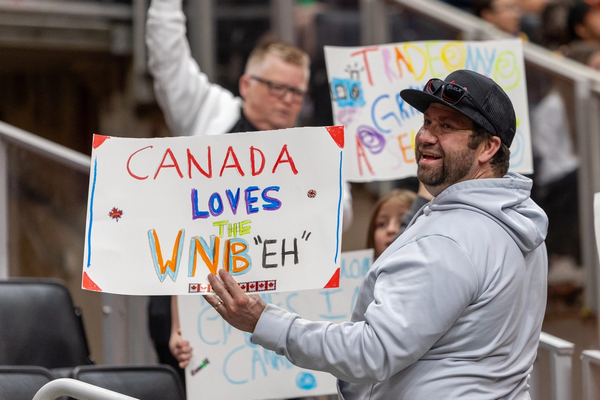
That strategy of genuinely valuing what women’s sporting events offer, especially from a commercial perspective, gives Edmonton credibility and leverage when leagues come to the table. “To be able to…say, ‘This is what we want, and this is true to our values, and this is what we want to see come out of these major events,’ I think that's the shift we're seeing in the relationship between host cities and rights holders in general,” Medynski said.
Edmonton is also showing bigger entities what it looks like to engage small, locally-based businesses for sponsorships. Since the city hosts so many one-off events, major multiyear deals don’t always make sense, and it’s not home to many corporate headquarters like Toronto or Vancouver, but Edmonton has smaller businesses offering valuable investment.
- Examples include Ace Liquor, which activated around the WNBA game, and ATB Financial, which has supported hockey initiatives for women and girls.
“They're seeing a lot of the business community get excited, just even on the corporate hospitality side,” she said. “And I think Golf Canada is even looking at their sponsorship models saying, ‘Hey, maybe we can look a little bit differently versus national sponsors that are signed for multiyear deals. Maybe Edmonton is leading the way and giving us an opportunity to bring in some of these smaller annual partnerships.’” Leading the way on and off the court.
Enjoying this article? Want more?

Sign up for The Call Up and receive sports industry intel straight to your inbox two times a week